
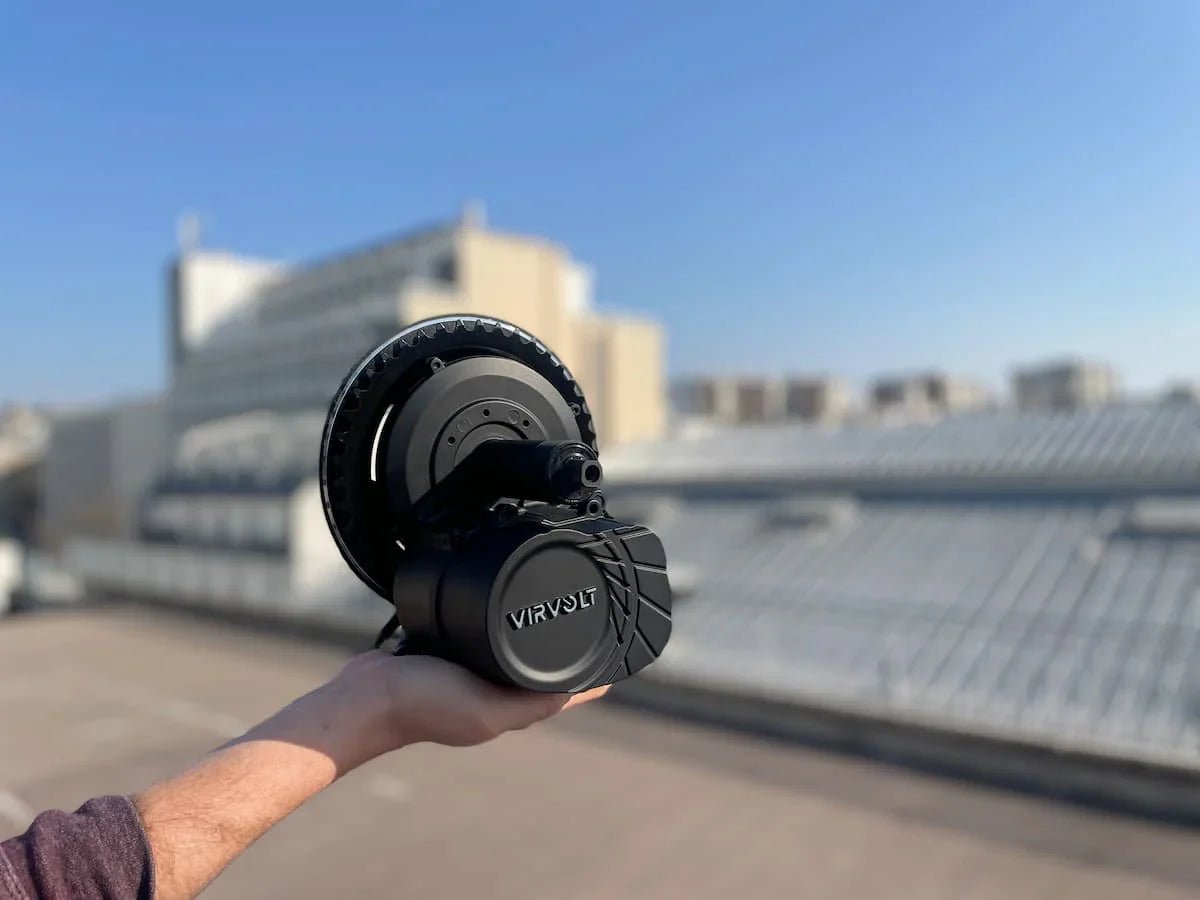
This is news we were eager to share with you.
Our Virvolt 900 bottom bracket motors are now 100% manufactured In France 🎉
We've literally been working on this for months. Day and night. With all our heart. Yes, relocating the industrial production of this product was for us. a crucial topic. For the environment. For the workforce. For expertise. For quality. For better control of the production chain. For improved satisfaction of our customers and partners.
But let's not get ahead of ourselves. Rome wasn't built in a day. Neither was Virvolt. 😎
In this article, we explain everything. (or almost). Our story, the product design process, the steps to arrive at this production (Finally) carried out in France, the advantages, but also and above all what we hope to achieve in the future. Let's go!

The design process of our engine
Because the history of Virvolt and that of our engine are closely linked [...] we decided to tell you everything. Here are the major milestones we have reached so far, and those we hope to reach in the future.
The story of Virvolt 🎥
- Virvolt was initially an electrification workshop. At that time, we electrified just about everything we could get our hands on. (skateboard, old motorcycle, etc…). Because we loved tinkering. Because we wanted to learn. For that, we relied on existing engines. Like, for example, the famous Bafang and Tongsheng engines, designed and manufactured in China. And then, by testing the products, we identified areas for improvement. So, we wanted to go further and do everything we could to solve them ourselves.

- This is where the Virvolt adventure as you know it today began. Our conclusion? The motor is one of the areas (along with the battery) where there's the most room for improvement. One point in particular is of great concern to us: repairability. (which had previously left much to be desired). And that's precisely why we're discussing it with key manufacturers, mostly Chinese. We quickly narrowed it down to one of them, who was very keen to work with us on this project. Its name? TSDZ2. We then co-designed an improved version of the existing engine, more in line with our requirements.
- It's time to create our first custom prototype. We're tackling several points: the aesthetics of the motor, the wiring, the clamping ring, the programming, and a multitude of other details. (of which we still keep some secrets). It's kind of like our grandmother's recipe.
- Meanwhile, once satisfied with the results, we launched the marketing of our first products. And it was a success! More than 4,000 people chose to electrify their bikes with Virvolt. A golden opportunity to gather new feedback and identify areas for further product improvement.We therefore continue to develop our motors (and associated electrification kits), until we arrive at the one we have today: the 900 engine.
- The next challenge? Relocating production. To achieve this, we felt it was essential to work hand in hand with an experienced partner. We then contacted a leading industrial player in France: Renault.
An industrial partnership with Renault Group at the Flins Refactory 🏭
This story had actually started a little earlier. 👇
Since Virvolt's early days, its offices have been located in the heart of Paris, in a former dealership. Renault in the heart of Paris, now dedicated to the mobility of tomorrow. It was time to take the discussions further and talk about industrialization.
We started by assembling a few engines in our offices. To understand the process. To master the subject. To identify the key issues to consider. And with all these elements in mind, we went to talk with the teams working on the Flins Refactory project. Here are a few... behind-the-scenes images from the factory.
Yes, their approach was very much in line with ours. With the Refactory, we want to reinvent ourselves to develop accessible, sustainable, local mobility solutions for everyone.

A closer look at the Virvolt 900 engine
First, two numbers.
Because we sometimes tend to forget it, but a mid-drive motor is a technical component. Our Virvolt 900 motor is composed of 55 references and 92 pieces in total.

Let's now look at the subject in more detail. 👇
The technical specifications of our bottom bracket motor
Here's what you need to know about our engine 👇
- Weight : 3 kg
- Rated power : 250W
- Couple developed : 80Nm
- Voltage : 36V
- Levels of assistance : 3 to 5
- Sensor type : couple
- Current called maximum : 17A
- Crankset compatibility : BSA 68/73 mm (or BSA >(120mm with adapter)
- Screen communication protocol : UART
- Additional outputs : Lighting and Gear Sensor
- Plateau : 42 teeth BCD 110 (5 holes)
- Assembly : France
The composition of our bottom bracket motor
What if we take a close-up look at the engine? Here's what you'll find there.
- The engine
- The custom-made Virvolt casing (designed in France)
- The nylon gear
- The Controller
- The dual clutch (makes pedaling easier without assistance)
- The 42-tooth chainring, 110BCD, 5 holes
- The star-shaped mounting bracket for the tray
- The front cover
- The deck housing
- The mounting plate
- The drive shaft

The 3 key elements of the Virvolt engine
We mentioned it in connection with the launch of the first Electric Assist Bicycle (EAB) with the great Bordeaux-based brand Jean Fourche; we designed our motor by focusing on 3 aspects that were particularly important to us:
- The performance ⚡: This is the key point. We designed this motor to be as efficient as possible, and above all, to meet the standards of the best new e-bikes on the market. No compromises: you'll ride with a pressure sensor to provide the most natural assistance possible and with 80 Nm of torque to help you climb the toughest mountain passes. (or the hill of Montmartre). Our goal? To offer you the greatest comfort during your bike journeys.
- Sustainability 🌎: Today, most new e-bikes are designed with the motor and battery integrated directly into the frame. This means repairs are often lengthy, complex, expensive, and sometimes impossible. The result? Products that aren't always durable and stray from the original concept of cycling: a simple, repairable product with a lifetime of use. With our motor, those days are over. It integrates seamlessly with virtually any bike on the market. We adapt to the bike frame, not the other way around. The motor is therefore interchangeable. It will accompany you from your city bike to your mountain bike, and who knows, maybe even your future cargo bike?
- Repairability 🔧: Although it's a legal requirement, spare parts for e-bikes and motors aren't always readily available or easy to find. Our motor offers a new alternative. It's compatible with most bikes and can be easily installed and removed. In case of breakage or wear, repairs are straightforward. Soon, all parts will be available through a catalog shared with all our partner retailers. No more diagnostic kits for professionals; our motor can be opened with a set of Allen keys and a screwdriver, and wear parts are easily replaced. This will allow them to maintain your bike in optimal condition for the long term.
What is the selling price for this bottom bracket motor?
As with any product, there is a wide range of engine prices and qualities available on the market. The budget varies depending on a large number of parameters. (quality of components, assembly location, logistics and delivery, chosen performance, etc.).
The Virvolt bottom bracket motor is designed to be efficient, durable and repairable.
It is now marketed through 👇
- Our Virvolt 900 Kit (comes with a 10 Ah or 20 Ah battery) Starting from €1200 including VAT at our partner retailers. We have chosen to work closely with over 250 bike shops across France. They will install the motor directly onto your bike, guaranteeing a safe and high-quality installation.
- For bicycle manufacturers or cycle craftsmen who are looking for a durable, repairable, and high-performance engine. Prices for this part are available upon request via contact@virvolt.fr
We can This allows us to confidently offer you a quality product from start to finish. All that remains for you is to take care of the final part, maintaining your bike and motor at home, so that it lasts as long as possible.
Does this engine comply with French standards? 🇫🇷
Of course! Here is a little more explanation. 👇
- There standard EN ISO 13849-1:2015 which focuses on machine safety
- There standard EN 15194:2017 Clause 4.2.15 which provides details on electromagnetic compatibility
- THE standards EN 61000-6-3 & EN 61000-6-1 who also talk about electromagnetic compatibility
- There RoHS standard which sets the restrictions concerning hazardous materials
Good to know: For each item, we also have the corresponding certificates of conformity. These are sent to each professional partner. Would you like to receive them in advance or get more information? Visit our contact form.
And what are the next steps for Virvolt?
We know there's still a long way to go. 💪
Indeed, while we assemble in France, we also dream, above all, of a kit with 100% French components. Currently, this isn't yet the case. We're progressing step by step, according to our resources. First, assembly. Then, little by little, we're relocating production and finding local partners for each part. This is the case, for example, with the motor installation cranks (made in Portugal), or the clamping ring (made in France).
Each part is a long and costly industrial process. We are doing our best to move forward as quickly as possible, but it is a process that will extend over several years.
FAQ: Bicycle bottom bracket motor 🚴♀
What are the advantages and disadvantages of a mid-drive motor?
The mid-drive motor is one of the three existing solutions on the market for electrifying a bicycle. (with front wheel motors and rear wheel motors).
The bottom bracket motor is recognized as being:
- The most powerful motor (equivalent to those in new e-bikes)
- The engine with the best balance and weight distribution
- The motor with the most comfortable electric assistance
How much does it cost to electrify a bicycle?
The price varies considerably depending on the options chosen (type of kit, place of manufacture, etc.). In France, it costs on average between €800 and €1500 to electrify a mechanical bicycle. By comparison, a new electric bicycle costs on average around €2000. (according to figures from the Union Sports et Cycles). Electrification kits are therefore a good choice for saving money.
How to convert a classic bicycle into an electric bicycle?
We discuss this in detail in our article. Why and how to electrify a bicycle. More specifically, 5 essential steps :
- Define your needs (average number of km, frequency of use, elevation gain, etc.)
- Look at existing solutions (front wheel motor, rear wheel motor, bottom bracket motor)
- Specify your budget (the overall package including the bicycle and the electrical components)
- Check for potential subsidies in your area
- Order and schedule an appointment with a professional for installation
Share:
Autonomy and lifespan of your electric bike kit
The ecological observation of a bicycle and the electric bicycle kit