
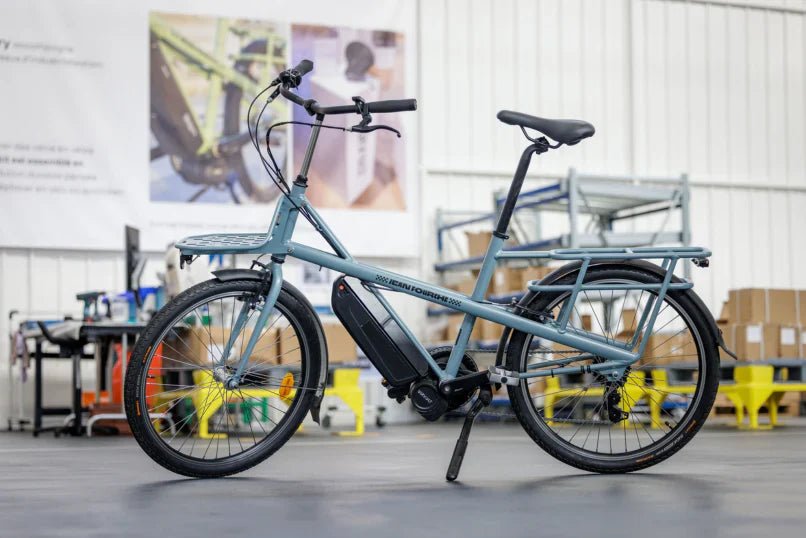
You'll know everything, absolutely everything, about the battery.
This is a key issue for electric bikes - e-bikes (and often perceived as complicated)).
And here, we are thinking more specifically about the aspect autonomy. Yes, we want to know two things:
- How many kilometers will each charge allow you to travel?
- How long will the battery last in the long term? Its lifespan, in other words.
This article explains everything you need to know about the subject. (calculations, units of measurement, standard battery life in France, battery life of batteries included in our electrification kits, etc...). Let's go!
Overview of the standard battery (optimal range 70km) of our electrification kit

A closer look at the context and regulations for electric bike (e-bike) batteries
No regulations for e-bike batteries in France 🇫🇷
Let's start with an essential point 👇
Currently, there are no clear regulations or universal calculation methods for bicycle battery range data. In other words, each manufacturer/retailer may have their own calculation method. This can be quite confusing for the end customer.
Good to know: Conversely, for cars, the subject is governed by the WLTP standard. This standard is mandatory and allows for a fair comparison between models.
The initiative of the German ZIV Association 🇪🇺
At the European level, an initiative has recently been launched.
This initiative was spearheaded by the German association ZIV (Zweirad Industrie Verband) and now brings together several key players in the sector. (Bosch, Accell Group, Shimano, Velotech).
In concrete terms, what does this consist of? They agreed on a unified testing protocol. (with an assistance factor of 200%). This makes it easier to compare the performance of different e-bike models between these different brands.
This test is the R200. Let's go into detail. The protocol sets standard values for speed, average pedaling frequency, weight, terrain type, soil type, starting frequency, weather conditions… In short, a whole range of criteria.
They are currently working to make this an international standard. Nothing is set in stone yet, but this could change in the coming years.
Other initiatives of this kind are starting to multiply. The observation? There is a real demand on this subject. This will allow for maximum transparency and better understanding for all stakeholders.

How many kilometers can you travel with an electric bike?
There is no universal answer, as you might suspect.
There are two aspects to consider 👇
- The performance of the bicycle : These are the advertised performance figures. (based on those measured under test conditions). This is how we can tell you about the average distance per charge. For the Virvolt kit, for example, there are two options: 70km and 120km of range. We'll come back to that.
- The use of the bicycle : A bicycle battery's performance is also highly dependent on standard usage parameters. Depending on how you use the bike, the range can vary, both increasing and decreasing. If you are a If you're lightweight, only ride on flat terrain, and use a very low level of assistance, the battery will last longer. Logically, this also works the other way around.
Good to know: In France, you'll generally find electric bikes (e-bikes) with a range of 50 km to 120 km. Logically, the price varies depending on the chosen range. It's up to you to determine which model best suits your needs.
How can I determine the battery life that best suits my needs?
We advise you to look at 4 elements first 👇
- The distance of your daily commutes (Google Maps (is your friend)
- The type of journeys (alone, with a load, on the road, etc…)
- The charging frequency that seems acceptable to you (every day or less)
- The average elevation gain on your daily commute (If the battery level is above 3%, choose the highest performing battery possible - you will be using it to its maximum capacity)
Now you have the elements, let's now look at the unit of measurement.
What unit should I use to measure the battery range of my electric bike (e-bike)?
It all depends on your battery capacity.
And this can be presented in 3 forms 👇
- In Ampere-hours (Ah) : This generally varies between 5Ah and 18Ah. For Virvolt products, it can go up to 20Ah.
- In Volts (V): That's the voltage. Basically, it defines the force delivered by the battery (that is, the energy that will be transmitted to the receivers). It's almost always 36V.
- In Watt-hours (Wh): The larger the battery capacity, the more energy it can hold, and the greater your range. On average, e-bike batteries range from 260 Wh to 375 Wh. Virvolt batteries go up to 700 Wh. In other words, you benefit from extended range and can either undertake long journeys or limit the number of daily charges.
How can you obtain the Watt-hour if you don't have it? Very simple. You need to multiply the voltage in volts (V) by the capacity in ampere-hours (Ah). Example: 36V x 14Ah = 501 Wh.
What is the lifespan of a standard electric bike battery?
A duration that is calculated in charge cycles
Before going any further, it is important to explain what is meant by battery life.
The key point to remember: we are talking in terms of the number of charge cycles ⚠
Generally, the manufacturer specifies a maximum number of charge cycles. Beyond that point, the battery is still functional, but its performance decreases. It therefore lasts less time and requires more frequent charging. This is how all batteries work, not just those for bicycles.
In short, batteries have three inevitable wear mechanisms: shape memory, wear, and temperature. No one can explain it better than Marie-Liesse Doublet, a researcher at the CNRS. For more details, we suggest you watch this... very cool video.
Battery life expressed in years
Taking into account the elements mentioned above, it is estimated that the batteries have a maximum lifespan of 500 charge cycles on average before losing autonomy.
And what does that mean in km? That's where the range widens.
- Average performance under test conditions : 500 charges
- Estimated optimal battery life : 70km
- Potential total autonomy : 40,000km
- Estimated lifespan:
- 12km (average commute to work) x 2 (you have to get home somehow): 24km/day
- 228 days (365 days – 105 weekend days – 7 public holidays (excluding solidarity day) – 5 weeks of paid leave) x 24km = 5472 km per year
- 40,000 (total potential range)/5472 = 7.3
The lifespan in an ideal world is therefore more than 7 years :)
As you've probably gathered, this figure is very theoretical. We'll leave it to you to recalculate it using your own case and actual data to get the most accurate result possible.
Good to know: Depending on how you use the bike and your profile, this range can therefore be more or less long.
What is the battery life of the Virvolt kit?
Our 900 electrification kit is available in 2 sizes 👇
- A standard battery (optimal range 70km) with 36V and 10.5Ah.
- A high-performance battery (optimal range of 120km) with 36V and 19.2Ah.
The choice therefore simply depends on your needs.

What factors influence the actual battery range of your bicycle?
- Battery capacity : Yes, as we saw earlier, that's the basic principle. Everything depends on the technical performance of the product itself.
- The assistance mode used : The higher the assistance level (for Virvolt kits, this would be level 5 out of 5), the faster the battery will drain. Conversely, the more you use the eco modes, the faster the battery will drain. (so for example 1 out of 5) The longer your battery will last.
- Your daily journey : As with the previous point, the more elevation gain your route has, the more assistance you'll need, and therefore the shorter your battery life will be. Frequent stops and starts also affect battery life, as the battery is used more during these times.
- The weather conditions : Yes, that matters too. The outside temperature, the wind (especially from the front) and time in general can play a role in your conduct and therefore the use of the battery.
- Your profile : The more weight you have (you, belongings, a baby carrier, etc.), the more you'll need to draw on the assistance system, and therefore the battery, which will impact the range. In short, at this point, you should have grasped the general idea.
4 tips to make your electric bike battery last as long as possible
- Opt for gentle pedal assistance. : The idea here is to use gentle assistance, especially during the starting phase. High assistance for starting will put maximum strain on the motor and battery, thus using a lot of energy. By starting with a low level of assistance, you can save up to 20%.
- Adjust the speed: For a walk, if the route is gentle (little elevation gain, little wind, etc…) Prioritize pedaling. On a daily basis, avoid sudden acceleration and also avoid constantly maintaining maximum speed. For cycling, the logic is the same as eco-driving in a car.
- Take care of your battery. Electric bike (e-bike) batteries do not like extreme temperatures (cold as well as hot). Our advice, when you are not using your bike, is therefore to store your battery in a dry place at room temperature.
- Don't overuse fast charging : On a daily basis, do not leave your battery charging continuously. (unless you have a built-in charging stop). Ideally, don't use the fast charging function too often. It's very convenient but damages the battery more quickly.
That's it, you know everything. Any feedback on the battery topic? Head to the comments section of this article or directly to our... contact form.
Partager:
Convert a classic bike into a cargo bike with an electric bike kit
The ecological observation of a bicycle and the electric bicycle kit