
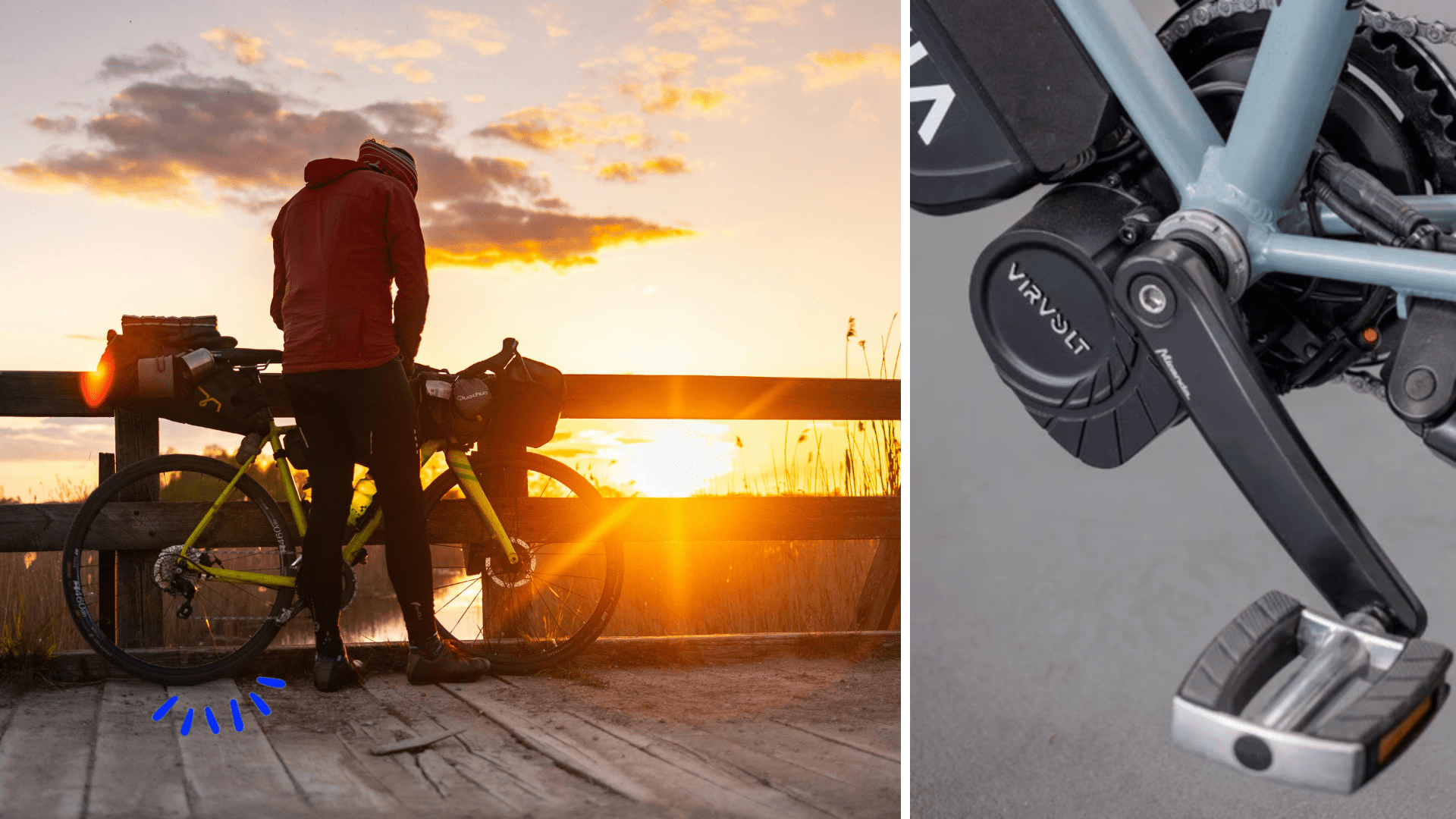
Bikepacking is booming. Every year, thousands of cyclists choose to embark on adventures, lightened panniers and free spirits, exploring back roads, hidden paths, and uncharted horizons. But while the desire for escape is certainly there, the legs don't always keep up. And if theelectrification of the bicycle allowed us to push back the limits?
The issue is no longer marginal. With the increasing availability of electric conversion kits, more and more bikepackers are looking to adapt their regular bicycles to add electric assistance. The goal isn't necessarily to go faster, but to be able to go further, with more load, more elevation gain… and fewer cramps.
But is it realistic? Is an electric bike compatible with the constraints of self-supported travel? Can we trust a motor and battery when crossing the Cévennes, the Alps, or the Balkans? What real-world range can we expect, and what compromises should we accept (weight, repairability, budget)?
Today, the electric kit market is gradually adapting to the requirements of bikepacking: more compact batteries, Lighter motors, discreet and silent systems. And yet, it's not all that simple: between compatibility issues, the added weight, legal limitations, and the need to remain autonomous without charging stations every 50 km, the choice is not to be taken lightly.
This article dissects this option. Is it heresy or a logical evolution? What do the pioneers say? Which kits should you choose for a long-distance trip? And above all: does electric assistance harm the spirit of bicycle touring—or does it renew it?
Summary
- Is it really possible to electrify your bike for bikepacking?
- What are the best kits for electrifying a bikepacking bike?
- What are the risks, limitations, and practical advice before electrifying your bike for bikepacking?
- Ultimately, electrifying your bike for a trip can be a great choice.
1. Is it really possible to electrify your bicycle for bikepacking?
Is it technically feasible?
Most bikes designed for bikepacking are fundamentally lightweight, simple, and sometimes even rustic. They prioritize mechanical reliability over electronic innovation. But that doesn't mean they're incompatible with electric assistance.
Yes, it is technically possible to electrify a touring bike — whether it's a gravel bike, a mountain bike, a steel touring bike, or even an old hybrid. The kits available today offer enough modularity to adapt to most configurations.
The two main options are:
- Wheel motors, simple to install, ideal for rolling or moderately hilly terrain.
- Bottom bracket motors are more efficient uphill, but more expensive and more complex to install.
At Virvolt we offer solutions designed for cyclists who want to keep their original bike — and their travel style.

What constraints should be anticipated?
But be warned: just because it's feasible doesn't mean it's always relevant. Electrification adds two major constraints: weight and energy management.
A complete kit (motor + battery) adds an average of 4 to 7 kg to your bike. That's not much when riding in the city, but when traveling, every gram counts — especially uphill or when you have to carry the bike on a trail.Furthermore, adding the battery reduces the space available for frame bags or luggage racks.
The other constraint is energy: the range of an electric bike in bikepacking depends not only on the battery capacity, but also on your route, your total weight, the wind, the type of assistance chosen, and even the temperature.
What is the actual range of a bicycle trip?
In theory, a kit with a 500 Wh battery can offer between 60 and 100 km of range. But this figure can drop to 40 km uphill or off-road, or climb to 120 km if you carefully manage the assistance and pedal hard.
In practice, bikepackers who electrify their bikes often adopt a hybrid riding style:
- Minimal assistance on flat terrain
- Boost when climbing or when fatigued
- Complete cut-off on descents or false flats
This careful management saves battery power… and allows you to maintain some effort during the journey.
Is this compatible with the spirit of bikepacking?
It's almost a philosophical question. For some purists, bikepacking should remain a "muscular" adventure, where slowness and sweat are part of the journey. But for others, electrification is a way to expand the realm of possibilities: covering more kilometers, tackling steeper mountain passes, carrying more gear, or traveling with friends of varying fitness levels.
It's not about cheating, but about adapting the experience to one's abilities, age, or available time. And above all, assistance sometimes allows... keep the desire to leave when we would otherwise have given up.
As Marine, our communications manager and bikepacking enthusiast, sums it up:
“Without electricity, I could never have made this trip. But I sleep in a tent and make my coffee with my cooking gear. I don't feel any less adventurous for it.”
Are there any risks in electrifying a touring bike?
Yes. As with any mechanical project, there are pitfalls to avoid:
- An improperly installed motor can unbalance the bicycle or damage the frame
- Excessive power (over 250W) makes your bicycle illegal on public roads
- A poor-quality battery can overheat or fail at the worst possible moment.
- A total overload (you + luggage + motor + battery) can exceed the limits specified by your frame.
That's why it's essential to choose your kit carefully, have it installed by a professional if possible, and test the whole thing on several local outings before going to the other side of the world.
Should you electrify your bike or buy a fully equipped e-bike?
It's the eternal alternative. Buy a new electric bike specifically designed for touring (like the Riese models). & Müller, Moustache, or Cube guarantees perfect integration of the electrical system, a geometry designed for weight reduction, and unwavering reliability. But the entry price often exceeds €3,500.
Conversely, electrifying your bike costs between €800 and €2,000, raises fewer logistical questions (you keep your bike), and allows for more precise customization. It's often the choice of travelers who go on occasional trips, or who want to try electric bikes first without changing their entire setup.
2. What are the best kits for electrifying a bikepacking bike?
Are there kits specifically designed for bikepacking?
The answer is no… but also yes. Officially, very few brands feature “bikepacking” in their marketing materials.But in reality, several electrification kits are particularly well suited to bicycle touring, thanks to their lightness, compactness and discreetness.
The idea here isn't to install a powerful motor like on a cargo delivery bike, but to opt for a smooth, economical, and above all, reliable long-term assistance system. We're therefore looking for a kit that doesn't compromise the bike's balance, recharges easily, and doesn't add 10 kilos to the assembly.
The best bikepacking kits are generally those that offer a good compromise between autonomy, efficiency, and ease of use. And in this category, several models stand out.
Which kits are best suited for 2025?
Virvolt 750

Probably the most popular kit among casual bikepackers. Very lightweight (less than 4 kg), easy to install, and compatible with almost all types of bicycles. The motor is housed in the rear wheel, and the removable battery attaches to the handlebars or frame.
Range: up to 70 km in eco mode.
This kit is ideal for short trips or stages of 60-70 km, provided you travel light. Its main advantage is its discreetness and small size.
Virvolt 900

Designed for urban cyclists, this kit is also increasingly popular with touring cyclists. It consists of a motor integrated into the bottom bracket and a compact battery that attaches to the downtube. Its advantage: it works very well with steel or gravel bikes.
Range: between 60 and 110 km depending on the terrain.
Its robustness and compatibility with disc brakes make it a relevant choice for mixed terrain (asphalt, trails).
How to choose the right kit for your trip?
It all depends on your practice.
-
Are you going on a 3-day greenway trip with 2 panniers?
Opt for a lightweight and economical kit like the Virvolt 750
-
Are you planning a 2-week trip to the mountains with bivouacking?
A robust mid-drive motor with a long battery life, like the Virvolt 900, is preferable.
-
Do you want to electrify an old steel bicycle?
Check the frame compatibility (axle spacing, brakes, rims), and choose a rear wheel kit if you do not want to modify the bottom bracket.
What mistakes should be avoided when making a choice?
The biggest pitfall is overestimating your power needs. Many travelers buy oversized kits, thinking that a 500W motor will help them better on climbs. Bad idea: not only are these kits illegal on public roads (the limit is set at 250W in Europe), but they are also heavier, consume more energy, and are often less reliable in the long run.
Another common mistake is not planning ahead for charging. When bikepacking, power outlets are scarce. You need to be able to recharge your battery easily, with a lightweight charger that's compatible with public charging stations or solar panels.
Finally, beware of low-priced kits sold online. Some do not meet CE standards, while others are impossible to repair if they break down. Opt for established brands with reliable after-sales service.
How much does a good kit for going on an adventure cost?
Prices vary depending on the options:
- Basic front wheel kit + small battery: from €690
- Rear wheel kit with improved range: from €890
- Mid-drive motor kit + long-range battery: from €1250
You may need to add professional fitting (between €80 and €250), and sometimes reinforcement of the brakes or transmission, especially if you are driving with a load.
But in absolute terms, you save several thousand euros compared to buying a new electric bike designed for touring.
3. What are the risks, limitations and practical advice before electrifying your bike for bikepacking?
Does electric assistance fundamentally change the travel experience?
Yes — but not necessarily in the way you might imagine. Electrifying your bike doesn't mean betraying the spirit of bikepacking, but it does require rethinking certain aspects of the trip: autonomy, logistics, maintenance, and the route.
With an electric bike, you ride faster, climb more easily, but you also become partially dependent on an external resource: electricity. This changes the way you plan your stages.
Properly calibrated assistance can also make travel more inclusive: for couples, across generations, or after an injury. Many travelers report a renewed sense of enjoyment thanks to electrification, especially when used as occasional support rather than a constant source of power.
What are the mechanical or technical risks?
An electric bike, especially in the context of long-distance travel, can be more vulnerable than a fully mechanical bike. Here are the main points to be aware of:
- Electrical connections: they must be protected from dust, water, and vibrations. A poorly secured cable can come loose after a day on the slopes.
- The battery: it is susceptible to shocks, high temperatures, and complete discharge. Some models are very sensitive to humidity.
- The motor: if it is of poor quality or incorrectly installed, it can overheat or seize up. A misaligned bottom bracket motor can cause premature wear on the drivetrain.
- The extra weight, added to the rear or center, changes the bike's balance. This can make handling less intuitive, especially on technical descents.
Before setting off, it's best to carry out several tests on varied terrain. A 100km ride in real-world conditions allows you to identify weaknesses and adjust the load or the assistance settings.
How to manage battery charging while roaming?
This is THE big question of electric bikepacking. Even with a 600 Wh battery, you'll eventually need to find a power outlet. Here are some strategies adopted by experienced travelers:
- Recharge overnight in campsites, guesthouses or with locals (via Warmshowers for example)
- Ask in cafes or restaurants along the way (in exchange for a drink).
- Use a power outlet in train stations, tourist offices or libraries — often available for free
- Carry a secondary battery to double the battery life (but be mindful of the weight).
And what if there's a breakdown in the middle of nowhere?
This is where electrification shows its limitations. A flat tire, a broken cable, or a dead battery can turn a great adventure into a nightmare.To minimize the risks:
- Choose a kit with standard parts (motor, connectors, battery)
- Learn how to diagnose basic faults (disconnected cable, blown fuse, frozen display)
- Bring along a small, specific emergency kit (Allen keys, connectors, insulating tape, printed instructions)
And above all, mentally prepare yourself to ride without assistance if necessary. All the kits mentioned in the previous section allow you to continue pedaling even if the assistance fails — with more effort, certainly, but without getting stuck.
What about the legislation regarding electric bikepacking?
In France as in the European Union, an electrified bicycle must meet the criteria of an electrically assisted bicycle (VAE) in order to be able to circulate freely without a license plate, mandatory helmet or specific insurance.
Here are the three essential criteria to be met:
- Motor limited to 250W
- Assistance that only activates when you pedal
- Assistance cuts off above 25 km/h
If you install a more powerful kit, or one with a throttle grip, you switch to the moped category. This means being banned from certain trails, mandatory insurance, and even registration.
In the context of bikepacking, it is therefore best to respect these thresholds, so as not to find yourself in violation during a check, especially in natural parks or abroad.
Some practical advice before you get started
- Test your setup on several local rides, with a full charge, to adjust the battery position and the power of assistance.
- Don't forget regular maintenance: tighten screws, check connections, monitor battery condition.
- Lighten the rest of your equipment to compensate for the weight of the electric kit. The goal remains to stay agile and self-sufficient.
- Have a plan B: an alternative route if the battery fails, shelter in case of breakdown, a local contact or resource location every 100 km.
- Keep the spirit of the journey in mind: assistance is there to help, not to turn bikepacking into a motorcycle tour. Pedaling remains the heart of the experience.

Finally, eElectrifying your bike for a trip can be a great choice
Electrifying your bike for a trip is neither heresy nor a betrayal. It's an option. An option that is becoming increasingly available to those who want to continue riding far, for long periods, with pleasure — despite physical limitations, the weight of panniers, or challenging climbs.
Provided you choose your kit carefully, test your setup, and adapt your expectations, electrification allows you to extend distances, dare to take on more demanding routes, or simply to set off when you would have given up.
But it's not a magic bullet. Adding a motor and battery involves compromises: more weight, more mechanical complexity, and a form of energy dependence to learn to manage. It's something you have to anticipate, prepare for, and accept as an integral part of the journey.
Ultimately, it's all about balance: becoming one with your machine, even an electric one. Remaining curious, self-reliant, and adaptable. Because that, in essence, is the essence of bikepacking.
Partager:
Virvolt 2000: the new French electric bike motor designed for cargo bikes
How to electrify a Decathlon or Intersport bike ? Our guide for each range