
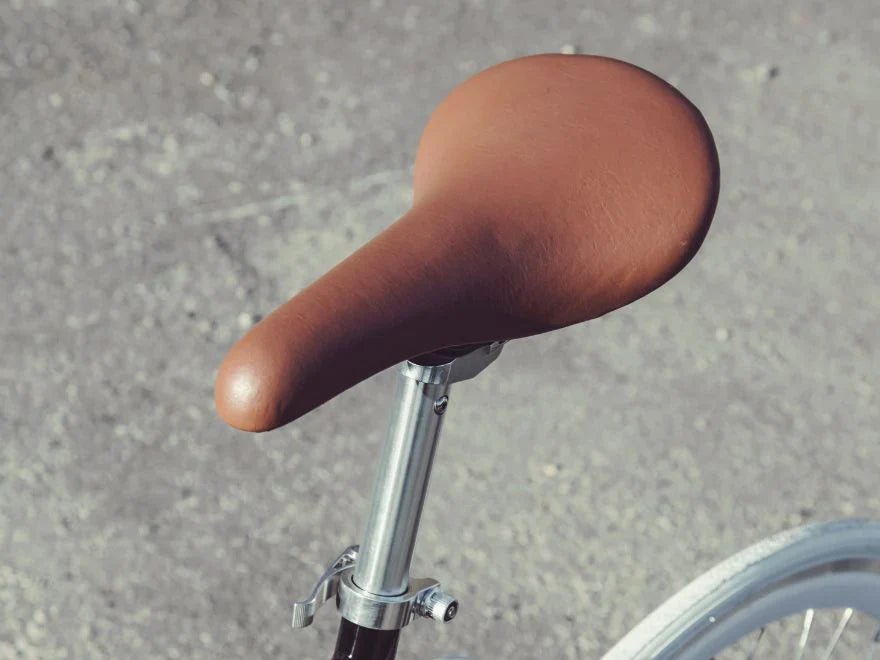
Want to get back into cycling — classic or electric — but worried about sore bums? Don't worry, it's a very common question, especially among beginners… and those who have just started.electrify their bike with an electric bike kit. The good news? There are many solutions to improve your cycling comfort, whether for your daily commute or long rides.
Just like a new pair of shoes, your body needs a little time to adjust. But with the right cycling gear (shorts, saddle cover, chamois base layer, etc.), good posture, and a few simple habits, it's entirely possible to cycle pain-free. This guide answers all your questions: What are the differences between an electric bike and a traditional bike in terms of comfort? Are some types of bikes more prone to pain (hybrid, mountain, gravel)? And which accessories can really make a difference?
We tell you everything in this dedicated guide.

Why do our buttocks hurt when we ride a bike?
Several reasons:
- Incorrect settings (saddle too high, too low, unsuitable shape, etc.)
- Inadequate equipment (aging saddle, missing shock absorbers, etc.)
- Lack of practice (as with any new activity, a little time is needed to adapt)
- Extreme temperatures (high heat, humidity, etc.)
- Moisture (from perspiration and salt which irritates the skin)
Good to know: To avoid sweating on the saddle, some cyclists—especially on e-bikes or over long distances—tend to sit too far forward. While this may reduce perspiration, this posture is far from ideal for comfort, particularly in the perineal area. Whether you ride a traditional bike or have chosen toelectrify your bike with a kit, It is essential to adopt a good riding position and use appropriate cycling equipment (ergonomic saddle, cycling shorts, breathable saddle cover, etc.) to avoid pain and improve daily cycling comfort.
Sore buttocks while cycling: what are the symptoms?
An important point before going any further.
These aches and pains can result from sitting for extended periods or from regular cycling. This can occur during long bike trips, but also when you decide to cycle for all your daily commutes.
This can be expressed in different ways 👇
- Irritation (on the thighs - where the skin potentially rubs against the saddle),
- Redness (following the same logic as the point above)
- Nodules (but rest assured, this happens very, very rarely)
- Sore areas (lower pelvis, perineum, genitals, fingers, etc.)
In the most extreme cases, and when this pain persists, it can lead to more bothersome issues (burning sensations, digestive problems, etc.). The good news? These cases are very rare and, above all, There are solutions.
6 tips to stop butt pain
Bike adjustment
It may seem basic, and yet: we still see far too many cyclists—including those on e-bikes or bikes equipped with an e-bike conversion kit—whose riding position isn't suited to their body. A poorly adjusted saddle, a stem that's too low, or the wrong handlebar height can quickly lead to pain, especially in the buttocks. If you experience discomfort while pedaling, the first step to regaining comfort on your bike is simple: check and adjust your settings.
Some elements 👇
- The saddle (height, distance, tilt)
- The handlebars (position, height, width, tilt)
- The length and angle of the stem (must be adjusted according to the length of your arms)
- The position of the brake and gear levers (They must be easily accessible and operable; you shouldn't have to break the handle to use them.)
- The length of the crank arms (very simple, the end of your knee should be aligned with the end of the front pedal crank)
If you do all that, there's a good chance the problem will be fixed. You have two options: you can do it at home. Not comfortable with that? You can go to a shop or a specialist to have your bike professionally adjusted.
Good to know : Some even go further and offer a postural analysis. If you plan to use the bike very regularly, this can be a great option. You'll then know exactly what you need in terms of equipment and adjustments.
Here is a diagram created by Vélomag This allows you to clearly understand the pressure points exerted on the saddle depending on your posture. It's evident that with an upright position, there are many more points of contact, but the pressure is better distributed.

Adjusting the saddle
As we briefly mentioned earlier, the saddle is a key element. Yes, it's what you sit on when you pedal, so it's important to be comfortable.
To adjust the seat height, there are two options. 👇
- The perceived option: You sit on the bike and place your foot on the pedal. Your heel should be flat on it and your leg straight. Then, make slight adjustments.
- The scientific option : Very quick. You need to measure your inseam. Generally, an adult's inseam is estimated to be between 65 and 95 centimeters. Once you have this measurement, simply multiply the result by 0.88. This will give you an approximate height for adjusting your saddle. Then, just refer to the markings on your saddle post, and you're all set.
Good to know: Bicycles are sold in different sizes and with saddles that have a limited height adjustment range. In other words, you can adjust it by raising or lowering it, but there's a limit. If you're 1.90 meters tall and you bought a size S bicycle, the seat post will be too short.
Choosing the right saddle
Often, for everyday use, people buy a bike as is and never change the saddle. But be aware that there are dozens of different saddle options (narrower, wider, foam, open in the middle, etc.). So, you're bound to find the right size for you.
Here are the three main forms that exist on the market today. 👇
- Rounded : Very pleasant for long journeys while maintaining comfort
- Plate : The sportier version, adapted for shorter distances
- Semi-rounded : Unsurprisingly, it's the happy medium

To help you choose the saddle, here are our recommendations. 👇
- The width: If you have wide hips, opt for a saddle that's slightly wider than average (around 135mm). This will give you a comfortable seat. The same principle applies in reverse. For narrower hips, a narrower saddle will be perfect. If you have a more upright riding position, choose a wider saddle. Conversely, for a more stretched-out position, choose a narrower saddle.
- The length: The average size is around 250 mm. Below that, the seat is simpler It's fast and has less friction. It's ideal for long distances or sports activities. Above that, it's the opposite.
- The material (titanium - the most comfortable, steel - just after in terms of comfort, aluminum - light but less comfortable, carbon - ultra-light and good vibration absorption but not necessarily comfortable).
Be aware that many shops today allow you to test bikes (and therefore saddles) before making a final purchase. We highly encourage you to take this step to find the perfect combination for you. The approach is the same as with shoes: you try on several sizes and shapes. The same principle applies to bikes.
Good to know: Some saddles have an empty central space, called a central channel. This can be a very good option for to reduce pressure on the perineum. This format is often recommended for women, but is becoming increasingly common in general.
Reinforced seat cover
Some retailers offer saddle covers. Some models are simply designed to protect the saddle from rain and should be removed once you get on the bike. Other models are padded (with gel, foam, etc.) and should be put on before getting on the bike.
This solution is not perfect.
A seat cover provides a soft and comfortable seat. However, it often also results in a slightly less stable seat, which can cause chafing. Some people love it, others less so. Feel free to try it out and see if it's the right solution for you.
The bib shorts
Ah, cycling shorts. We also use the term “cyclist” in cycling jargon.
That famous garment that gives the impression of wearing a diaper the first time.More specifically, it's a type of close-fitting short (designed for both women and men) with padding in the crotch area, providing support for the seat. It's very practical for long journeys or cycling trips. However, for everyday use, it requires a bit more planning. To address this issue, some brands offer underwear with a chamois pad. This is more discreet and easy to wear under trousers.
Following the same logic as for the saddle cover, the best thing to do is to test it and form your own opinion.
Good to know: Cycling shorts are an item of equipment used by all professional cyclists and the cycling world in general.
Anti-chafing creams and solutions
Whether it's summer or winter, on the road, friction can damage your skin. Whether you're on an electric or regular bike, it's the same. The only difference? With an electric bike, you pedal slightly less (or at least with less force), which reduces friction.
Here are some solutions to reduce friction. 👇
- Vaseline (the solution that has always worked)
- Chamois cream (it is also antibacterial): chamois cream is applied to the skin and to the chamois leather of the bike a few minutes before starting your ride.
- Protective balm (also known as “cyclists’ balm”)
- Applying talcum powder to irritations to soothe pain and prevent the spread of bacteria;
Good to know : Choose clothing that is not too short, otherwise the skin may rub directly against the saddle and quickly become irritated.

FAQ: Sore buttocks while cycling
Why does my coccyx hurt when I ride my bike?
This usually happens if you have a very upright riding position (like on Dutch bikes, for example). The reason? Your coccyx is closer to the saddle and therefore under more strain. This is exacerbated if your saddle is thin. In this case, there's no need to change bikes; simply install a wider saddle or add a seat cover. That will do the trick.
How to avoid pain in the ischial tuberosities?
As a reminder, this is the lower, posterior part of the iliac bone. In other words (less scientifically speaking)? These are the "butt bones." This pain usually appears when you first start cycling. You should wait a few weeks while your buttocks naturally develop a stratum corneum, which will strengthen them and thus reduce the pain.
We hope these tips for taking care of your buttocks will help you We hope you'll be happy to see us on the cycle paths of France, with a big smile. See you soon!
Partager:
Where to transform your bike with an electric bike kit in 2023 ?
Everything you need to know about the weight of electric bicycles (VAE)